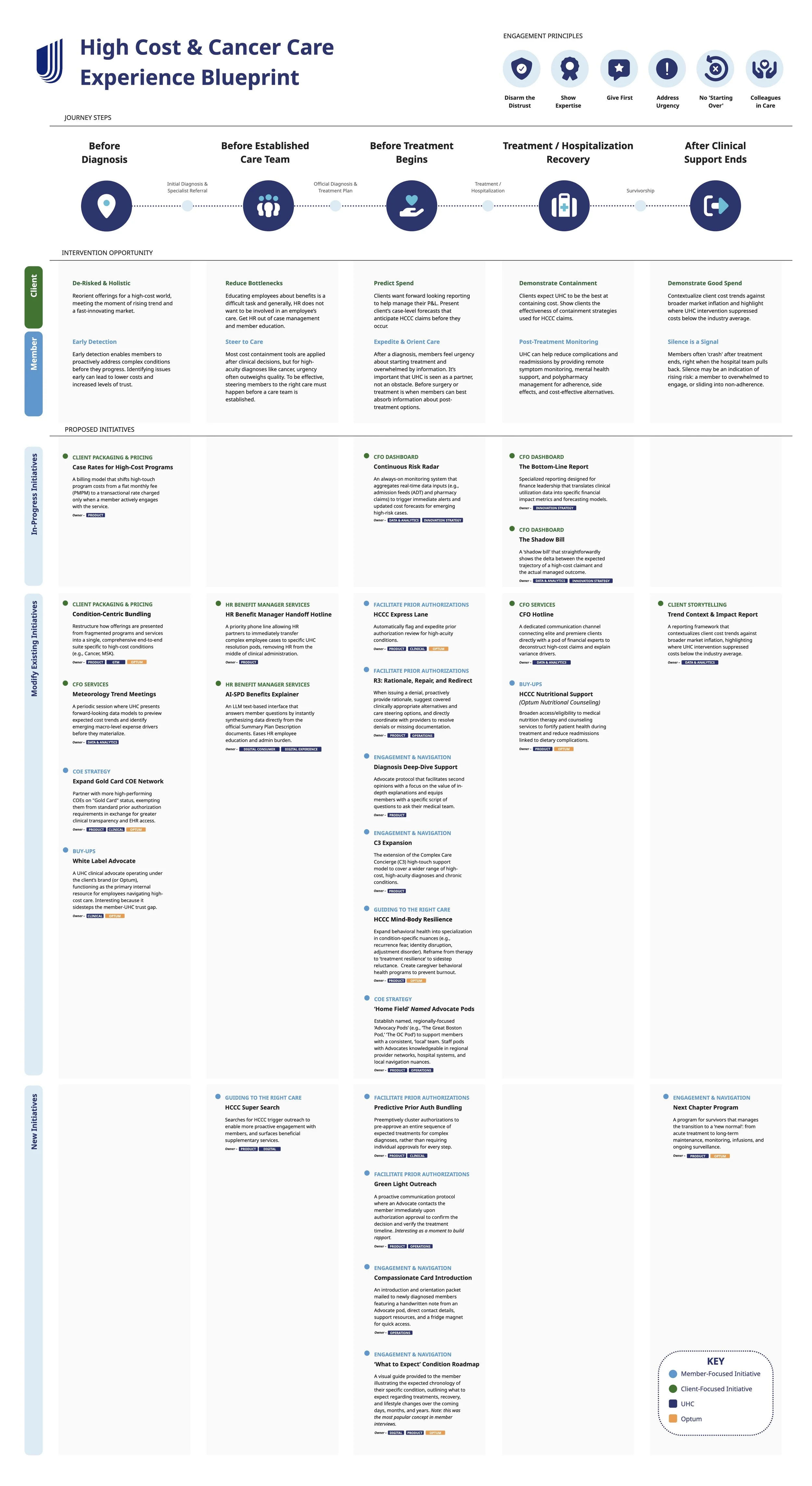
UHC High Cost & Cancer Care
Fall 2025 | DIRECTOR and ENGAGEMENT LEAD AT EPAM Continuum
Objective
As healthcare costs continue to rise, particularly in the area of high-cost claims, UnitedHealthcare (UHC) engaged EPAM Continuum to collaborate on targeted solutions in three key areas:
Benefit Clients
Deliver value to clients to help manage and contain cost and show focus on high-cost claimants and cancer as a priority.
Benefit Members
Improve the high-cost member experience by identifying high-impact, holistic solutions.
Benefit UHC
Focus on solutions that decrease impactable costs to demonstrate value to UHC and clients.
Research & Insights
RESEARCH Approach
16
UHC Internal Interviews
16
Market Scan Offerings Reviewed
5
Social Media Platforms Scanned
5
Client Interviews
1
Consultant Interview
22
Member Interviews
Focus Areas for Containing Costs & Supporting Members
For this work and in our research, we focused on containment strategies that more directly touch members and clients. We did not investigate containment strategies around contracting or working with providers.
Care Delivery Optimization
Improving where and how care is delivered to reduce waste & variability
Steerage
Network Management & COEs
Site of Care Optimization
Clinical Oversight & Management
Ensure that care is medically necessary, coordinated, and effective
Complex Case Management
Care Coordination
Utilization Management
Member Engagement
& Incentive Design
Influence member behavior through plan structure, education, support tools
Advocacy & Navigation
Member Engagement & Education
Treatment adherence
Gap Closure
Data, Evidence, & Continuous Improvement
Data, analytics, & research to refine decisions and policies over time
Predictive Analytics
Member Condition Focus
Solid Tumor Cancers
Hematologic Malignancies
Advanced Cardiovascular
Solid Organ Transplants
MSK
Autoimmune / Specialty Drug
Gene/Cell Therapy Candidates (market needs to shake out), NICU/Premature Birth (brand risk), Diabetes with Complications and Morbid Obesity & Related Risks (pending impact from GLP-1s becoming broadly available) were not in scope.
Key Themes & Opportunities for Clients
Predictability of Spend: Clients are frustrated by backward-looking reporting: they want forward looking reporting to help manage their P&L.
Demonstrated Containment: While clients don’t expect savings per se, they do expect UHC to be the best at containing trend.
Spend That’s Good For Members: UHC is expected to justify outlays by continuously demonstrating that it is ‘good spend’ – that the member received necessary and high-quality care.
HR Wants Employees Taken Care of During a Crisis: They prefer savings to emerge from better outcomes, not restrictions.
Open Enrollment Amnesia: Employees ignore benefit details when they are healthy.
HR is the 'Emergency Release Valve' for System Bureaucracy: In moments of medical crisis, some escalate directly to their internal HR leaders for help.
High Costs are Increasing Clients’ Risk Exposure: Some clients fear the stop-loss safety net is fraying, citing increased lasering. Some are optimizing plans for catastrophe.
Case Rates De-Risk Trying Innovative but Expensive Programs: Case Rate feels more financially efficient, and it psychologically lowers the barrier to trying innovative or high-cost, high-touch programs.
Seeking Holistic Condition Care, Not Piecemeal: Clients feel like they’re buying components of care, what they want is the outcomes and member experience of care.
Key Themes & Opportunities for Members
Simplify & Remove Roadblocks: Reduce friction in the ‘block & tackle’ of delivering high-cost and cancer care.
Send an Olive Branch: Proactively make a small gesture to show members you are available to them.
Evaluating Quality Care: Help our members evaluate and choose high quality care in high-cost and cancer care.
Aggressive Steering to Optimal Sites of Care & Clinical Path: The best way to steer a member to a preferred UHC provider is by finding it for them.
Round Out the Team: Offer ‘clicks ins’ to clinical care that doctors don’t have time for.
Administrative Assistant Wanted: A nurse navigator to explain things is nice, but an administrative assistant is needed.
Take Care of the ‘Backburner’ and Help the Member’s Village Help Them: Help the member and caregiver recover some bandwidth. Friends and family want to help but don't know how. Caregivers struggle to ask for help or delegate.
Close the Mental Health Gap: HCCC members often underestimate or defer the mental health impact as they rush into treatment. Typical mental health support falls short: effective support must be proactive and disease-specific.
New Tech for Adherence, Persistence, & Flareups: Tracking and monitoring of symptoms and the member’s condition to better triage care.
Early Detection as a Core Competency: Once a member becomes high cost, the ability to control costs is marginal.